
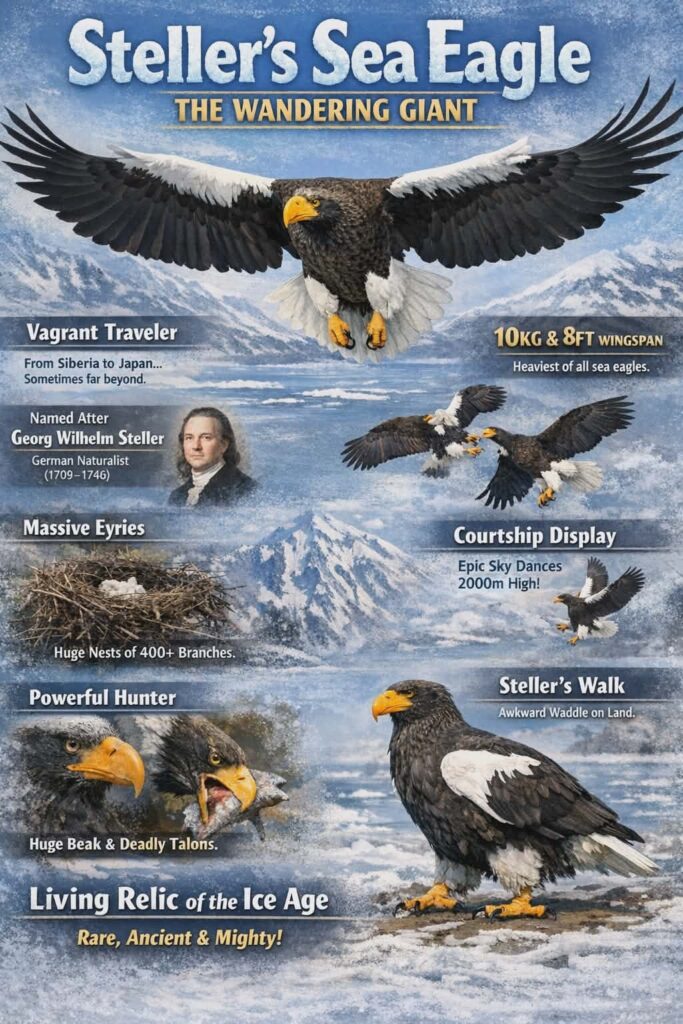
Stellers sea eagle -Mor eryr steller
Order Falconiformes
Genus Haliaeetus
species pelagicus
Often called the worlds magnificent bird of pre. ,they are also known as the Pacific sea eagle. The largest of all the sea eagles, and the heaviest known glacial relics, through multiple ice age cycles.
Females bodyweight range from 14 to 20lb, and males weighing in at around 11 to 15lb their body weight is typically variable. The large body size and distribution of the stellers sea eagle, evolving in a sub arctic zone, and have never occured anywhere else. Populations and species of a larger size are always found in colder environments. An ecogeographical rule derives from the relationship between linear dimensions, meaning that both height and volume will increase in colder environments, and this is known as the Bergmann”s rule. A pattern described by German biologist Carl Bergmann. The Stellers eagle is therefore seen as a terrifying mass, when sitting still, but if you add on an enormous beak, the largest of any living eagle, a sole known culmin measurement of around 2.5 to 3.0 inches, and the bill from the gape to the tip reaching 4.6 inches, just surpassing that of the Philippine eagle, talons, and flight momentum, this eagle packs some serious punch.
The Stellers sea eagle, is one of the rarest raptors in the world, with only an estimated population of 5,000, with numbers decreasing, due to direct persecution, and global climate change, and flooding, which has caused almost complete nesting failure for the eagles nesting in Russian rivers, flooding hampers the ability of the eagle parents to capture fish essential for their eyass and nestling survival.
Stellers sea eagles have distinctive behaviors related to their specialized diet, and their requirement to survive freezing temperatures.
The Stellers sea eagle is endemic to coastal Asia, where it lives in Russia, Korea, Japan, and China, it preys on fish and water birds, but will also be forced to move inland and scavenge on deer carcasses.
Solitary vs Congregatory, whilst this species is solitary or Forming monogamous pairs, they will gather in large numbers sometimes hundreds, where food is abundant, such as spawning ground in rivers in Russia. they will often roost communally near feeding sites during the winter with numbers peaking in late February.
The Kmachatka pennisula, in far eastern russia, is known for this birds relatively large population of around 4,000 of these eagles that live there. this mighty eagle is listed as vulnerable on the ICUN red list
The Stellers eagle was once described initially by naturalist Peter Simon Pallas in 1811, as Aquila pelagica. The species name pelagica derives from the ancient Greek term pelagos, meaning open sea. the genus Haliaeetus was given to this species in 1849 by George Robert Gray. Today the stellers sea eagle has been designated the official name by the international ornithologists union, and named thus after the German naturalist Georg Wilhelm Steller. In Russia it is known as the white shouldered eagle, and in Japan it is called o washi, meaning great eagle, in Mandarin it is called the tiger headed sea eagle.
Did you know in 1996, an analysis b gene of the mitrochondrial DNA of the stellers eagle, showed that the stellers eagles diverged from a linage that gave rise to the bald eagle and white tail sea eagle, around 4 million years ago.
Stellers eagles migrate from breeding grounds to Korea, Japan, China in the winter, most birds winter south of their breeding range, in the southern Kuril islands, Russia, and Hokkaido, the The Stellers eagle is less prone to vagrancy than the white tailed eagle, as this species lacks long range breeding dispersal typical of juveniles of that species, and the bald eagle, however vagrant eagles have been found wandering in North America, to include the Kodiak island, as well as the Aleutian islands, as well as, a single individual noted in Newfoundland, Maine recently
.There are 3 sources confirming wingspan of this species. 8ft 10, 9ft, 9ft 2 respectively, if this is true in the maximum wingspan, then this could quite be the largest wingspan of any eagle. Also Stellers sea eagles are unique among sea eagles in that they possess 14 and not 12 rectrices, a Latin word for helmsman, which help the bird to brake and steer in flight. these are the tail feathers.
Mature Stellers sea eagles have mostly dark, almost black Plumage, with a strong contrasting white on the shoulders, thighs, and wedge shaped tail, notably longer than the white tailed eagle. The bold pied coloration plays a part in social hierarchies with other eagles of their own during non breeding season, although not studied extensively.
Did you know that occasionally Stellers sea eagles can moult at adulthood into a rare black morph.
Despite their weight and size, stellers eagles are surprisingly agile raptors, and their copulation rituals are an opportunity to show this off alongside their pied colouration. such mating dances, can occur as high up as 2,000mtrs, and involve the male circling and stooping in undulating spirals over the much larger female. rapid stooping like this is a sign of a powerful and adept hunter and thus persuading the female that the male has genes necessary to sire strong offspring. when the demonstration is successful,he will let ot a deep and barking victory cry, that can be heard 3km away.
Stellers eagles build massive nests, often 2meters across, in large trees, or on rocky cliffs, typically high up , pairs return to their breeding territory annually. female lays 1-3 eggs typical April or May, with two being the average, both parents are involved in raising their offspring. at 5 weeks of age the chicks are huge and can consume 1 pound of fish day, fledging occurs between the range of 70 – 90 days.
In most of the Haliaeetus genus, the sea eagles the feet and tail are relatively short, compared to other eagles, specializations developed to capture fish,.
stellers eagles are also known for the stellers eagle walk, displaying vulture like swaying, comical gait while navigating on pack ice and frozen terrain, these majestic eagles use this ground movement to move between feeding spots, when scavenging commonly observed in winter peak times in Hokkaido, Japan, in a behavioural context this walk can also be quite dominating and part of competitive foraging and sometimes stealing fish from other birds such as crows gulls, and white tailed eagles, this stealing behaviour is also known as Kleptoparasitism, also seen in ancestral kites.
This species of eagle is vulnerable, making these encounters in the wild natural winter habitat truly special
The incredible power of this majestic eagle is incomparable, their dietary power and strength alone allows them to lift and carry large prey in varied ecosystems even seizing young Stellers sea lions, sometimes the weight is that of their own bodyweight. and this is why the Stellers Sea eagle is regarded as the heaviest eagle in the world.