
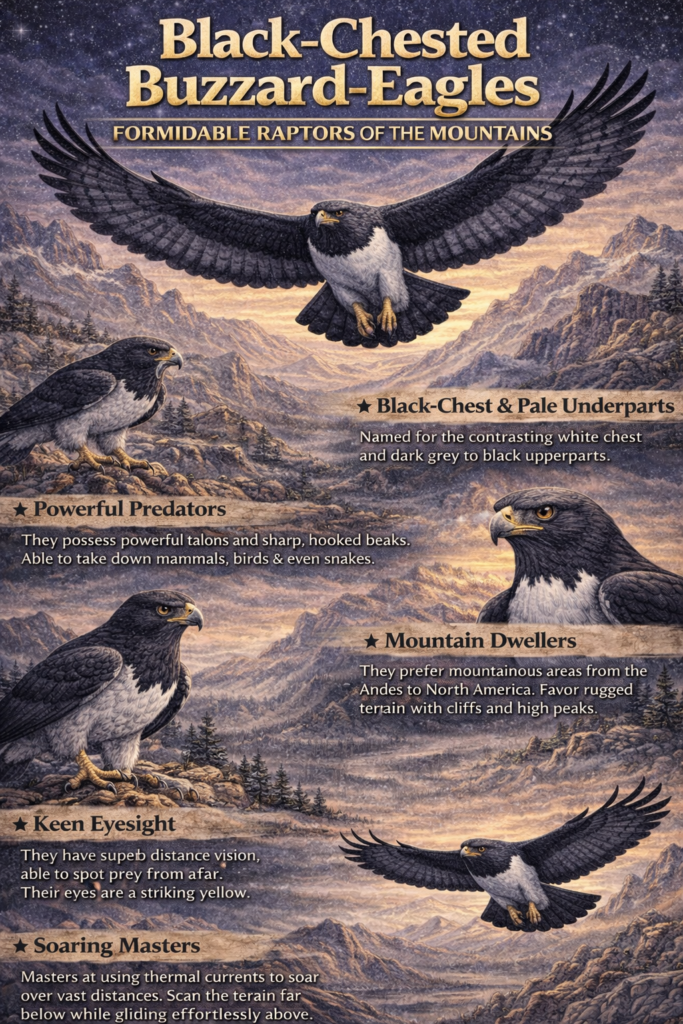
Black chested buzzard eagle-Barcud bronddu
Falconiformes
This species of raptor is a very large eagle like buzzard, very strong and powerful. it possess a short wedge shaped tail and long broad wings. a member of the hawk and eagle family Accipitidae, it lives in open regions of south America, and also found in mountainous or hilly terrain with sparse vegetation and shrubland, or in the south of its range, the Nothofagus forest where this species spends alot of its time soaring on vertical drafts and thermals looking for prey. this species requires very large territory with suitable habitat, and the north of its range such as the Paramos for example provides little of the former, thus only been recorded in the largest patches of habitat, such as that of the Paramo de Frontino, Most commonly found around 5,000ft,and 15,000ft and rarely ventures into the lowlands. it is most conspicuous mid morning and afternoon seeking the best spots for soaring ideally North and west facing slopes, where also at this time of day is also good for aerial displays and play.
there are two subspecies of this large raptor
The black chested buzzard eagle is also commonly known as the Chilean eagle, with a scientific name Geronoaetus melanoleucus, meaning crane eagle due to its blue grey coloration noted for its bulky build, and when perched, the long wings cover the tail mostly, giving this raptor a unique, near tail less appearance.
Adults have a white underside, with fine blackish stripes. the feathers on the neck and lowest dark feathers on the breast are elongated, and have an almost ash grey and white zone on the wings, almost silvery white seen from afar. the immature plumage is similar to that of a great black hawk, variable hawk, having upperparts that are a deep brown and no light wing patches. immatures do not gain adult plumage until they bare full adult around 4 – 5 years old.
this species nests on rocky cliffs, and high trees and even in caci. and is also noted to nest in bushes or even upon the ground. nesting has been observed in Ecuador all year round where elsewhere breeding season is more restricted. they construct a very large nest of sticks and are likely to reuse an existing nest rather than build a new one. pairs form bonds over several weeks, and engage in prolonged courtship flights. whilst not aggressive under normal out of breeding circumstances, this species will fiercely attack humans if it considers itself or offspring threatened
The black chested buzzard eagle is not a very vocal species, only calling usually in flight and when flying very close to its nest site, the call can be similar to a human laugh, or even a curlew like whistle ,and sound sometimes very much like our common buzzard here in the UK.
The food of this hypercarnivore consists mainly of medium sized mammals the European rabbit has become their main prey item, which has proved very helpful to farmers. is known to also seize avian prey, and if the need arises will also feed on carrion and invertebrates. The dark chested buzzard eagle is near to the top of the avian food chain in its range, and since it is the only Andean eagle found outside forest habitats it may also compete with other species, especially if carrion is available, compete with the very large Andean condor. researchers have documented the black chested buzzard eagle, raiding nests, and observations of at least one individual chasing flying ants and in many areas throughout its range these buzzard eagles depend upon domestic pigeons as an important food source.
The dark breasted buzzard eagle, and whilst it is rare and declining in some areas such as the Rion Grande do Sol, or in parts of Argentina its habitat requirements mean that to some degree benefit for deforestation, colonizing regions former Mata Atlantica forest in Alagoas, the overall range of this species is of least concern by the ICUN. Researchers in Brazil believe this raptors range is expanding, where as in Chile this raptors populations appear to be declining due to direct persecution.
EVOLUTION
Did you know that this south American raptor evolved from a small hawk lineages to become larger and more robust to occupy high elevation niches such as the Andes, showing strong evelutionary adaptions for hunting and scavenging, with large 6ft broad wings for maneuvering, and its short wedge shaped tail. it is closely related to the variable hawk, and red backed hawk, and example of a small hawk lineage evolving into a larger eagle like bird with eagle like traits to fill specific ecological niches, acting as a bridge between larger hawks and smaller eagles. a skilled hunter and very efficient scavenger a trait that is facilitated by success over varying terrains and climates.