
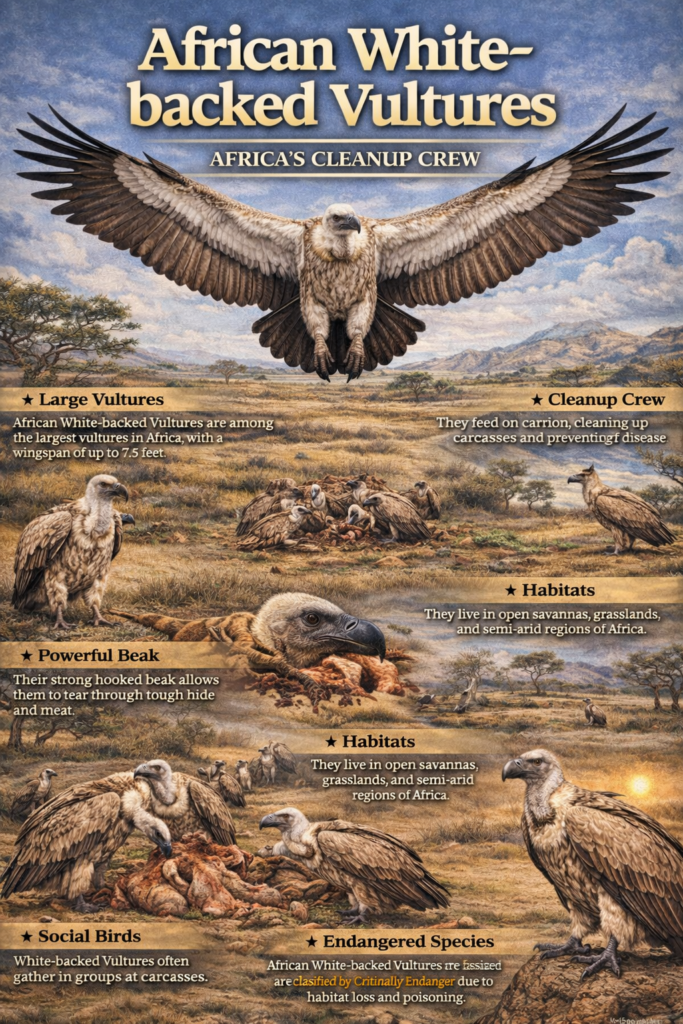
African White-backed Vulture – Gyps africanus
Order Accipitriformes
Genus Gyps – Old World vultures
African white-backed vultures, Gyps africanus, are medium–large, diurnal birds of prey found across sub-Saharan Africa, belonging to the Old World vulture group. They are easily recognised by their dark brown plumage, pale underparts, bald dark head, and distinctive white patch on the lower back which is most visible in flight. Unlike eagles, they have relatively weak feet but possess a powerful hooked beak adapted for tearing flesh. They are obligate scavengers, feeding almost entirely on carrion, and play a vital ecological role by rapidly consuming carcasses and preventing the spread of disease. They are highly social birds, often feeding in large groups, sometimes hundreds at a single carcass, and rely on both keen eyesight and the behaviour of other scavengers to locate food.
African white-backed vultures inhabit open savannas, grasslands, and woodlands where large herbivores are present, and they are masters of soaring flight, using thermals and updrafts to travel vast distances, sometimes over 100km in a day, with minimal energy expenditure. Adults range from 31 to 39 inches in length with a wingspan of approximately 6.3 to 7.5 feet, and weigh between 9 and 16 pounds, with females slightly larger than males, demonstrating mild sexual dimorphism. They nest in tall trees such as acacias, often in loose colonies, building stick nests where they typically lay a single egg per year, with both parents contributing to incubation and chick rearing.
These vultures have excellent eyesight, allowing them to spot carcasses from great distances, and possess strong stomach acids capable of neutralising dangerous pathogens such as anthrax and botulism, making them essential “clean-up” species in their ecosystems. They are mostly resident but may move locally in response to food availability rather than undertaking true long-distance migrations. Social hierarchies are often observed at feeding sites, with dominant individuals gaining priority access to food.
Did you know African white-backed vultures can descend rapidly to carcasses once spotted, forming large spiralling flocks in the sky known as “kettles,” and can strip a carcass in minutes? Despite their ecological importance, they are now listed as critically endangered due to rapid population declines of over 80–90% in recent decades. Major threats include poisoning (both intentional and accidental), habitat loss, collisions with power lines, and use in traditional medicine. In some cases, poachers deliberately poison carcasses to kill vultures, preventing them from alerting authorities to illegal kills.
This species is a stark contrast to the success story of the bald eagle, representing one of the most urgent conservation crises among birds of prey today. Efforts are underway across Africa to establish vulture safe zones, reduce poisoning, and monitor populations, but the species remains at significant risk.
SUPER FACT
EVOLUTIONARY ORIGINS
Old World vultures like the African white-backed vulture evolved separately from New World vultures, despite their similar appearance, an example of convergent evolution. Their ancestors adapted for a scavenging lifestyle, developing specialised traits such as bald heads for hygiene and broad wings for efficient soaring over vast landscapes.