
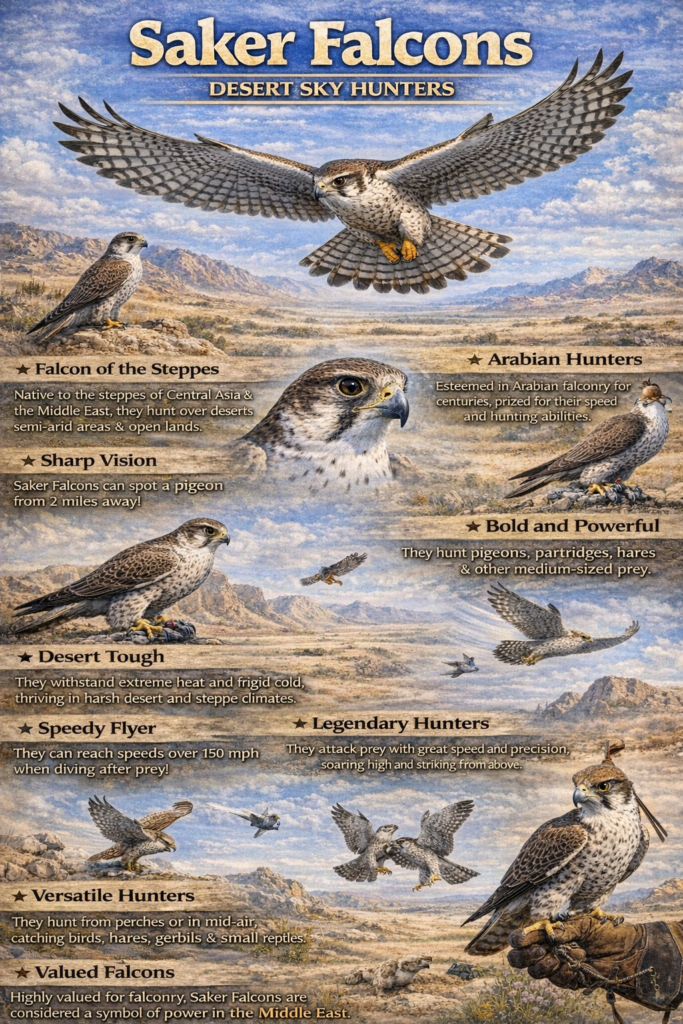
Saker Falcon – Falco cherrug
Order Falconiformes
Genus Falco – falcons
Saker falcons, Falco cherrug, are large, diurnal birds of prey found across eastern Europe and Asia, belonging to the falcon group. They are easily recognised by their powerful build, broad wings, and variable plumage ranging from pale sandy brown to darker brown, often with streaked underparts and a relatively less defined facial “moustache” compared to peregrine falcons. Their robust structure and long wings give them a strong, purposeful appearance in flight.
Saker falcons inhabit open landscapes such as steppes, grasslands, semi-deserts, and agricultural areas, often favouring wide, open terrain where they can hunt effectively. Adults typically measure around 18–23 inches in length with a wingspan of approximately 3.5–4.5 feet, and weigh between 1.5 and 3 pounds, with females significantly larger than males, demonstrating sexual dimorphism. They are partially migratory, with some populations moving south during winter.
They are powerful and versatile hunters, feeding mainly on small to medium-sized mammals such as ground squirrels, as well as birds. Unlike peregrine falcons, which specialise in high-speed stoops, saker falcons often hunt using fast, low-level chases and sustained pursuit, relying on speed, strength, and endurance rather than extreme diving speeds.
Saker falcons do not usually build their own nests, instead using abandoned nests of other large birds such as crows or buzzards, or nesting on cliffs and artificial structures. The female typically lays 3–5 eggs, with the male providing food while she incubates, and both parents caring for the young after hatching.
Did you know the saker falcon has been highly prized in falconry for centuries, particularly across the Middle East and Central Asia, where it has been used to hunt game such as houbara bustards? This long-standing relationship with humans has made it one of the most culturally significant falcon species.
Saker falcons have excellent eyesight and strong talons, allowing them to capture fast-moving prey across open landscapes. Their combination of speed, stamina, and adaptability makes them one of the dominant aerial predators of the Eurasian steppes.
SUPER FACT
EVOLUTIONARY ORIGINS
Falcons of the genus Falco evolved as highly specialised aerial predators, developing streamlined bodies, pointed wings, and powerful flight muscles. The saker falcon represents a lineage adapted for open-country hunting, combining speed with endurance to pursue prey over long distances in expansive landscapes.