
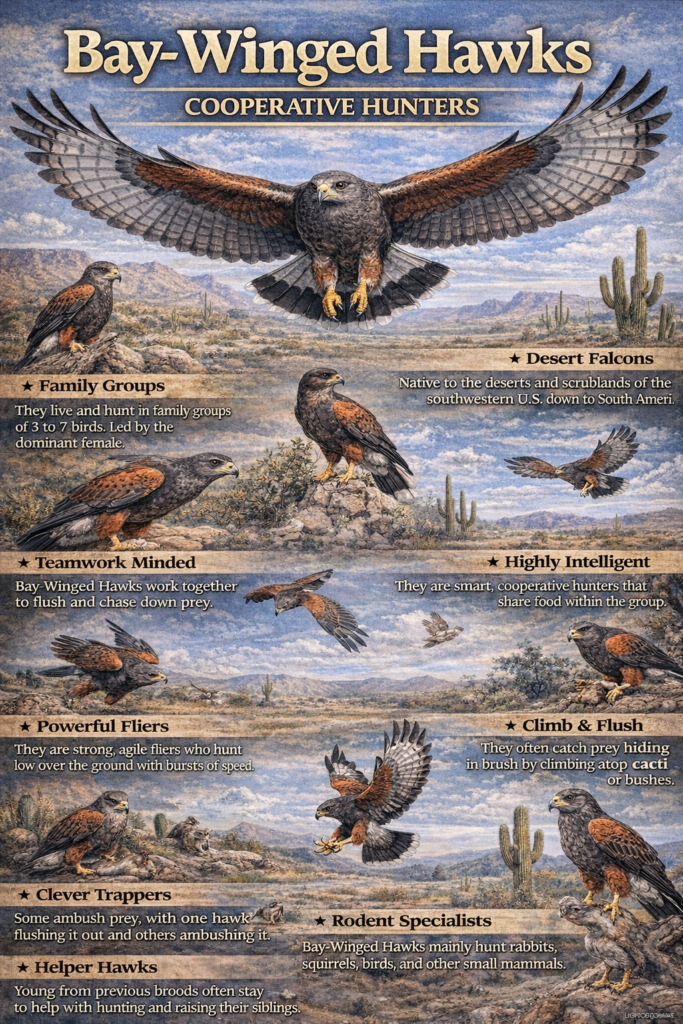
Bay-winged Hawk – Parabuteo unicinctus (Harris’s Hawk)
Order Accipitriformes
Genus Parabuteo – social hawks
Bay-winged hawks, more commonly known as Harris’s hawks, Parabuteo unicinctus, are medium–large, diurnal birds of prey native to the Americas, particularly the southwestern United States, Central America, and South America. They are easily recognised by their dark brown plumage, rich chestnut (bay-coloured) shoulders and thighs, white band at the base of the tail, and long yellow legs. Their striking colouration and relatively long legs give them a distinctive appearance among hawks. Both sexes look similar, though females are noticeably larger, demonstrating sexual dimorphism.
Harris’s hawks inhabit open and semi-arid environments such as deserts, scrublands, and savannas, often with scattered trees or cacti for perching and nesting. Adults typically measure around 18–24 inches in length with a wingspan of approximately 3.5–4 feet, and weigh between 1.5 and 2.5 pounds. They are generally resident birds and do not undertake long migrations.
Unlike most birds of prey, Harris’s hawks are highly social and are famous for their cooperative hunting behaviour, often hunting in family groups. These groups work together to flush out and capture prey such as rabbits, rodents, birds, and reptiles, taking turns in different roles during the hunt. This pack-like hunting strategy is extremely rare among raptors and increases their hunting success, especially in harsh desert environments.
They build stick nests in trees, shrubs, or cacti, and breeding is often cooperative, with multiple individuals assisting in raising the young. The female typically lays 2–4 eggs, and helpers may assist with incubation, feeding, and protection of the chicks. This cooperative breeding system is another unusual trait among birds of prey.
Did you know Harris’s hawks are widely used in falconry due to their intelligence, trainability, and social nature, often forming strong working relationships with humans? Their cooperative instincts make them particularly responsive compared to more solitary raptors.
They have excellent eyesight and strong talons for capturing prey, and their long legs help them navigate through dense vegetation and pursue prey on the ground. Their adaptability and social behaviour make them one of the most unique and studied raptors in the world.
SUPER FACT
EVOLUTIONARY ORIGINS
The genus Parabuteo represents a distinct evolutionary path among hawks, with Harris’s hawk developing social and cooperative hunting strategies rather than the typical solitary behaviour seen in most raptors. This adaptation allows them to exploit prey in challenging environments, making them one of the few truly social birds of prey.