
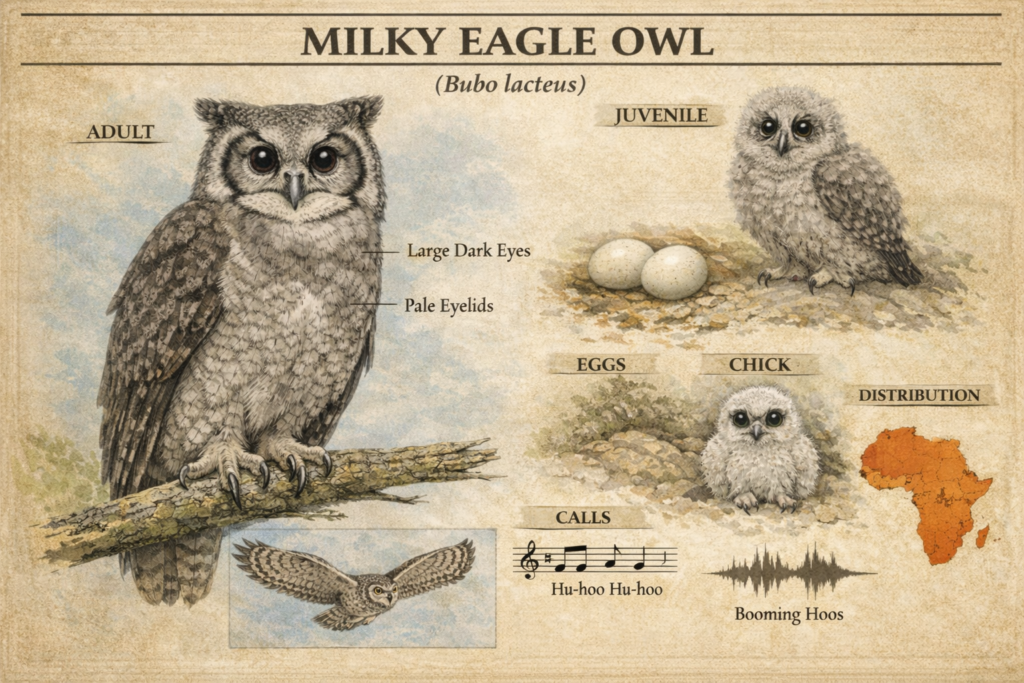
Verreaux Eagle Owl –Tylluan Eryr Verreaux
Order Strigiformes
Family-Strigidae
Genus- Ketupa
The gentle giant
The Verreaux eagle owl is up there with the heaviest of all the owls, and has super large feet. Ranking 4th in both weight and length of of all known owl species. they are very impressive, and certainly lives up to its dual name.
Also known as the giant eagle owl, Milky eagle owl, the verreaux eagle owl Ketupa lactea, is are large member of the fish owl family. A nocturnal Sub Saharan Africa bird of prey, and are the largest owl species in Africa. it is absent from most deep rainforests the highest densities are eastern and southern Africa. however they range up to as far as the Republic of the Congo.
This species inhabits mainly savannah with scattered trees and thorny vegetation, mainly inhabiting rather dry regions. they do also range into riverine forest adjacent to savanna and small semi open woodland, and vary scarce in mountainous regions. they range from sea level up to 3,000m.
There are no known subspecies and remarkably little variation in their appearance across considerable distribution. However birds in the southern range appear marginally larger, and may be considered as a mild case of the Bergmanns rule. At one time, the Verreaux eagle owl was mentioned as an owl with particularly mysterious genetic alliances among living owls.
Among species with available genomes to study DNA characteristics it has reveled that the fish owls in particular the brown fish owl is the third most closely related species to the Verreaux eagle owl and along with their fish owl cousins, were found to be sufficiently divergent to quailify as the separate Genus Ketupa. Also subsequent genetic testing appeared to confirm the relationship of the Verreaux eagle owl with the Fraziers and Shelley eagle owl. The Verreaux eagle owl descended from slightly smaller ancestors that increased with size as they diversified from related species.
They are easily recognised by their pale grey to coloured plumage, heavily streaked and mottled with darker markings, large size, and distinctive milky/pink eyelids which are especially noticeable when the eyes are partially closed. They possess prominent ear tufts, powerful talons, and a strong hooked beak, making them formidable nocturnal predators. Their deep, resonant hooting calls can carry over long distances, especially at night. Their calls are a very deep, gutteral and booming Gwonk Gwonk, travelling up to 6km, when defending territories, which are extremely large ranging up to 17000acres.
Milky eagle owls inhabit a wide range of environments across sub-Saharan Africa, including savannas, open woodlands, riverine forests, and semi-arid regions, often favouring areas with large trees for roosting. Adults typically measure around 23–28 inches in length with a wingspan of approximately 4.5–6 feet, and weigh between 3.5 and 5.5 pounds, with females noticeably larger than males, demonstrating sexual dimorphism. They are generally sedentary and maintain territories year-round.
These owls are powerful and opportunistic hunters, feeding on a wide variety of prey including mammals (such as hares and rodents), birds, reptiles, amphibians, and even other raptors. They hunt primarily at night, using silent flight enabled by specialised feather structure, combined with exceptional hearing and vision, to locate prey in low-light conditions. Their asymmetrical ear placement allows them to pinpoint sounds with remarkable accuracy.
Milky eagle owls do not typically build their own nests, instead using abandoned nests of large birds such as eagles or hamerkops, or occasionally nesting in tree hollows or on ledges. They usually lay 1–2 eggs, with the female primarily responsible for incubation while the male provides food. Both parents care for the young after hatching.
Did you know milky eagle owls are capable of taking surprisingly large prey, sometimes including animals as big as small antelope or large birds, and are considered apex nocturnal predators in their ecosystems? Despite their size and strength, they are generally elusive and rarely seen during the day, roosting quietly in dense foliage, in invasive eucalyptus trees.
Milky eagle owls have excellent night vision and highly developed hearing, allowing them to detect even faint movements in complete darkness. Like other owls, they can rotate their heads up to 270 degrees, giving them a wide field of view without moving their bodies.
This species has been documented to roost together, usually family members, consisting of breeding pairs and their offspring and engage in allo preening during this time.it has been reported some family groups included owls that hatched up to 3 years prior.
During extremely hot days mid afternoon, this species may flutter its throat, known as gular fluttering, and has been known to bathe in shallow water during extreme heat, but usually drinks at night.
verreaux eagle owls are presently listed as least concern on the ICUN red list, however
Verreaux eagle owls are seldom encountered species, occurring in low densities and having large territories, the threats that face this species are typical with that of other birds of prey from around the world. not infrequently they are locally rare due to persecution, and residual effects of pesticides, rodenticides, and direct poisoning events, alongside habitat destruction, as they require ample trees with large bird nests in order to take residence in a given area, this species is now considered near threatened, and has been recommended for threatened status in southern Africa overall.
This owl species is named after Jules Verreaux, a botanist and ornithologist from France.
african Verreaux eagle owls have a lifespan of approx 16 -20 years in the wild, with some individuals at bird of prey centres living for over 30 years. this owls become reproductive around 4-6 years of age.
SUPER FACT
EVOLUTIONARY ORIGINS
Eagle owls of the genus Bubo evolved as powerful nocturnal predators, developing adaptations such as silent flight, forward-facing eyes for depth perception, and specialised hearing structures. The milky eagle owl represents one of the largest and most dominant members of its lineage in Africa, occupying a top predatory niche in nocturnal ecosystems.