
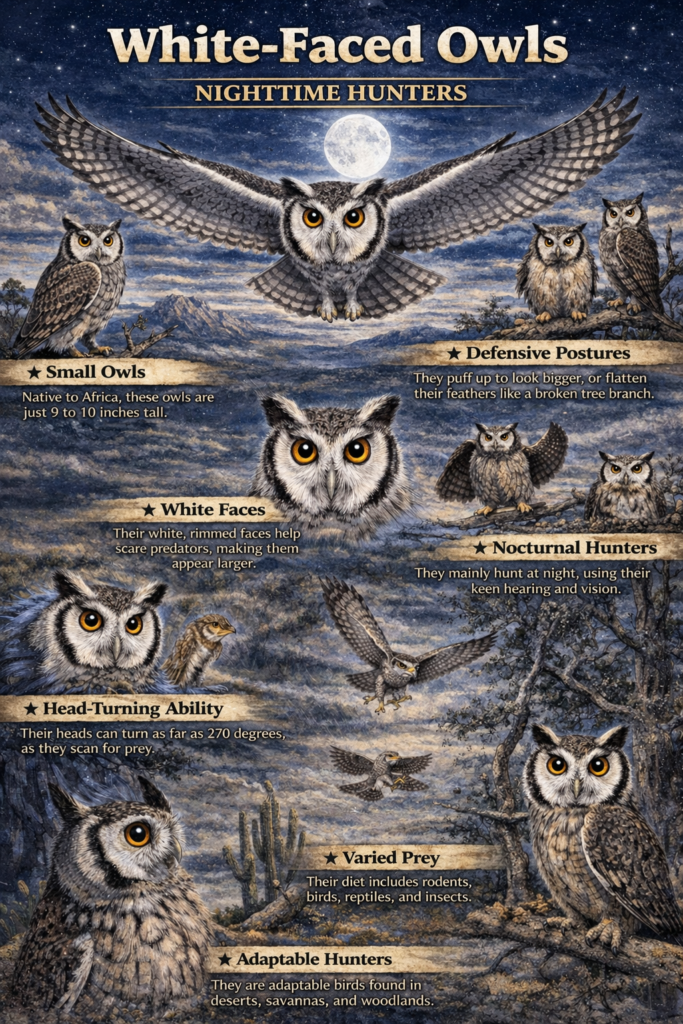
Southern white faced owl – Tylluan wyneb-wen y de
Order Strigiformes
family Strigidae
Genus ptilopsis
Known as the philomonic owl due to the males song of a series of fast bubbling hoots, utterd at night and frequently repeated by several males. these fast staccato notes followed by lonnger and higher pitched hoots are extensivly used during the breeding season as the pairs of owls often sing together. note that the norther white faced owl has a very different song.
A member of the Scops owl family, an old world species, native to the southern half of Africa, it was formally regarded as a subspecies of the Northern white faced owl, but is now commonly treated as a separate species.
Southern white faced owls are also known as the white faced scops owl, and are found from southern Uganda, Kenya, and the Dominican Republic of the Congo to south Africa, most common in Namibia, Botswana, Zimbabwe, Mozambique, and North eastern South Africa.
These owls occupy a wide variety of habitats, but prefer more open areas that still provide some shelter, and cover, such as dry savannahs, scattered with tree cover and thorny shrubs. They also appear in semi-forested areas bordering close to rivers.
Southern white faced owls and their northern counterparts, are almost identical in appearance, Southern white faced owls are generally a darker grey, but not reliable as both species vary in color, they range from 24cm long and weigh approx. 185g – 240g for males, and up to 275g in females, with a wingspan between 191 and 206mm. they have a basal metabolic rate of 0.06 cubic centimeters of oxygen an hour.
Temperature adaptability
After the summer, Southern white faced owls increase their resting metabolic rate by approximately 45% to adjust to the climate changes, they do this to increase cold temperature tolerance which is unusual for these creatures, and not only that, the basal metabolic rate of this species of owl is lower than what is expected of other birds similar size, which helps them when there is a lack of food and other resources through the winter.
Southern white faced owls have pronounced white and black facial markings, with a prominent black rim on either side, the eye color of these owls also differs from the typical yellow of most scops owls, and are orange-red. the plumicorns /ear tufts are long and the same color as the crown feathers, with little back streaks, and the breast feathers have many fine vermiculations.
There is little sexual dimorphism between sexes, the only notable difference being females generally weigh a little heavier than males. Sothern white faced owls are monogamous, and their eggs, clutch size of 2-4, are layed between may and November, peaking July and august, however on rare occasions they will lay as early as February. when chicks hatch they are exclusively fed by the male. Chicks fledge at 4 weeks of age, remaining in the surrounding cover of bush for 2-5 days until they can fly well. two weeks after that and around approximately 7 weeks old they leave the natal ground completely. southern white faced owls typically produce one clutch per year. 30 days of incubation.
they have a long lifespan
Southern white faced owls have been noted to live until 30 years old in a human based environment.
Southern white faced owls out of breeding season are strictly nocturnal hunters, and hunt their prey from perch to perch, once prey is located they fly to the ground and snatch it up.
Southern white faced owls are known to for their ability to transform their appearance to evade predators, either by puffing up to double their size, or slimming down for camouflage against surrounding branches and shifting this appearance to appear almost 2 dimensional. This behavior gives them the nickname the transforming owl.
dietry habits
White faced owls prey on rodents such as shrews, squirrels, birds ,invertebrates such as scorpions, beetles, and giant crickets, such as the park town prawn. and small reptiles. the largest recorded prey items are mourning doves and brush squirrels, but the majority of their diet is made up of 80% small rodents, where they have been noted to fly long distances to grass fires to prey on rodents and insects fleeing from the fire.
southern white faced owls are often preyed upon by larger owls, and to protect themselves they will hide in hollow trees or dense foliage during the day. if their predators are on average 35 to 75cm tall, white faced owls will expand their feathers and crouch, swaying with their wings open side to side to appear more big and intimidating, this is known as sunfaning, if the predator is larger than 75cm tall, southern white faced owls stretch as tall as possible, closing their wings tight to their bodies and keep their eyes half closed, and flicking their nictating membrane which is a strong form of blue, which keeps their visual acuity clear.
by preying on small rodents southern white faced owls aid in rodent population control.
southern white faced owls are not considered threatend, by the ICUN, and are locally a common species of small owl, except where pesticides, and rodenticides are common.
research has proved that Ptilopsis is a sister group to the genus Asio, the eared owls.
Southern white faced owls possess, what appears to look like a moustache to human onlookers, and some children even recognizing them as the moustache owl. Southern white faced owls have whisker features, stiff rictal bristles around their beaks, and below their eyes, these whisker like feathers assist the owl to feel,and navigate small prey items with their eyes closed, each rictal bristle possess a little sensitive organ at the base of the follicle known as the herbsts organ, and helps direct the owls senses, when feeding so that the eyes dont get damaged.
for more on owl senses please read more on our barn owl fact sheet
scops owls are typical owls in the family Strigidae, and restricted to the old world, and contains 59 species, and are separated from the American, new world screech owls, in Mega scops, based on range, biogeographical, behavioral, and morphological DNA sequence data. considered sister lineages filled essentially the same ecological niche in their allopatric, which means when a biological population become geographically separated from each other. scops and screech owl lineage separated perhaps 5mya,, with the hypothesis, that screech owls evolved from old world scops.
southern white faced owls have lived 5,000 years, and are primarily solitary birds.