
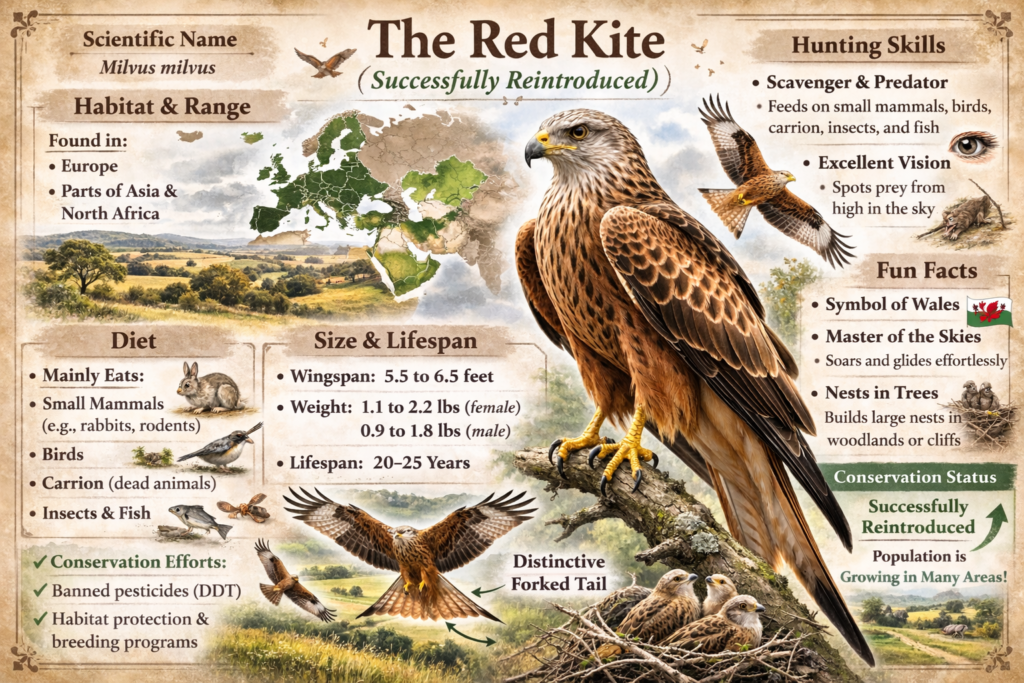
Red Kite – Milvus milvus
Order Accipitriformes
Genus Milvus – kites
Red kites, Milvus milvus, are medium–large, diurnal birds of prey native to Europe and parts of western Asia, belonging to the kite group within the Accipitridae family. They are easily recognised by their rich reddish-brown body, pale grey head, and long, deeply forked tail, which is one of their most distinctive features and is constantly twisted and adjusted in flight for precise manoeuvrability. Their wings are long and angled, with contrasting pale patches and dark wingtips, giving them an elegant, buoyant appearance when soaring.
Red kites inhabit open countryside, farmland, woodlands, and rural landscapes, often favouring areas with a mix of woodland for nesting and open land for foraging. Adults typically measure around 24–26 inches in length with a wingspan of approximately 5.5–6.5 feet, and weigh between 1.8 and 3 pounds. Females are slightly larger than males, showing mild sexual dimorphism. They are largely resident in milder parts of their range, such as the UK, while northern populations may migrate south during winter.
Red kites are opportunistic feeders, consuming a varied diet that includes carrion, small mammals, birds, and invertebrates. They are well known for scavenging and will often take advantage of roadkill or food scraps, and may also catch live prey with slow, graceful swooping movements rather than high-speed pursuit. Their flight is highly distinctive, characterised by effortless soaring and constant tail adjustments, making them one of the most recognisable raptors in the sky.
They build nests in trees using sticks, often reusing and adding to them over successive years. Breeding pairs are generally monogamous and may use the same territory annually. The female typically lays 2–3 eggs, with both parents involved in raising the young, though the male provides most of the food during incubation.
Did you know red kites have one of the most remarkable conservation stories in the UK, particularly in Wales? By the late 19th century, red kites had been driven to near extinction across Britain due to persecution, poisoning, and habitat loss, surviving only in remote parts of rural mid-Wales. At one point, the entire UK population was reduced to just a handful of breeding pairs, making Wales the last stronghold for the species. Thanks to strict protection, dedicated monitoring, and later reintroduction programmes across the UK, the population gradually recovered. Wales played a crucial role in this recovery, acting as the source population for reintroductions, and today red kites are once again a common sight across much of Britain, symbolising one of the greatest wildlife conservation successes in Welsh history.
Red kites have excellent eyesight, allowing them to detect food from considerable distances, and their lightweight build and large wings enable them to remain airborne for long periods with minimal effort. Unlike more aggressive raptors, they are relatively non-confrontational and often avoid direct competition with larger birds of prey.
SUPER FACT
EVOLUTIONARY ORIGINS
Kites of the genus Milvus evolved as highly efficient aerial scavengers and foragers, developing long wings and deeply forked tails that allow exceptional control and agility in the air. The red kite represents a specialised adaptation for low-energy soaring and opportunistic feeding, occupying a unique ecological niche between active hunters and scavengers.