
Lanner Falcon – Falco biarmicus
Order Falconiformes
Genus Falco – falcons
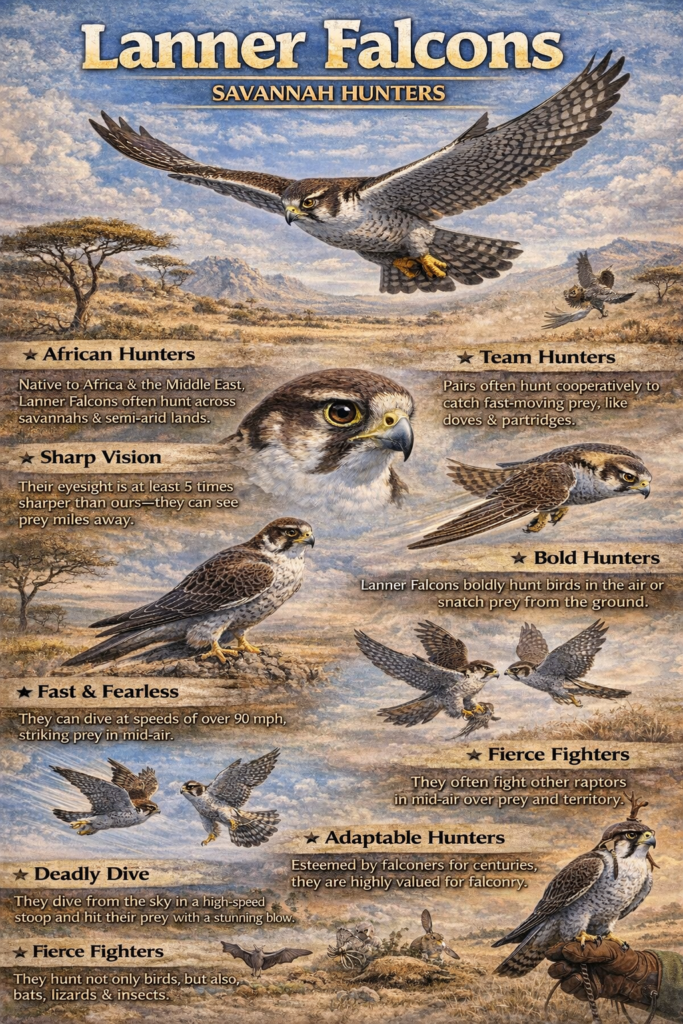
Lanner falcons, Falco biarmicus, are medium–large, diurnal birds of prey found across Africa, parts of southern Europe, and western Asia, belonging to the falcon group. They are easily recognised by their slim, athletic build, long pointed wings, and pale underparts with fine streaking. Their upperparts are generally brown to bluish-grey depending on region, and they have a distinctive pale head with a dark eye stripe (moustache), though less bold than that of the peregrine falcon. Their overall appearance is lighter and less contrasting than many other falcons.
Lanner falcons inhabit open landscapes such as savannas, grasslands, semi-deserts, and rocky areas, often favouring cliffs or open terrain with scattered trees. Adults typically measure around 16–20 inches in length with a wingspan of approximately 3–4 feet, and weigh between 1 and 2 pounds, with females noticeably larger than males, demonstrating sexual dimorphism. They are generally resident, though some populations may move locally depending on food availability.
They are fast and agile hunters, feeding primarily on birds, which they catch in flight, but will also take small mammals, reptiles, and insects. Unlike peregrine falcons, which rely heavily on high-speed stoops, lanner falcons often hunt using horizontal chases, low-level pursuits, and cooperative hunting techniques, sometimes working in pairs to flush and capture prey. Their flight is powerful and versatile, combining speed with endurance.
Lanner falcons do not usually build their own nests, instead using abandoned nests of other large birds on cliffs, trees, or pylons. The female typically lays 2–4 eggs, with the male providing food while she incubates, and both parents caring for the young after hatching.
Did you know lanner falcons have been used in falconry for thousands of years, particularly in the Middle East and parts of Africa, valued for their speed, stamina, and cooperative hunting style? They are considered one of the classic falconry species.
Lanner falcons have excellent eyesight and strong talons, allowing them to capture agile prey in open environments. Their adaptability to different habitats and hunting strategies makes them highly successful predators across a wide geographic range.
SUPER FACT
EVOLUTIONARY ORIGINS
Falcons of the genus Falco evolved as highly specialised aerial hunters, developing streamlined bodies, pointed wings, and powerful flight muscles. The lanner falcon represents a versatile branch of this lineage, adapted for both high-speed flight and sustained pursuit, allowing it to exploit a wide range of prey in open habitats.