
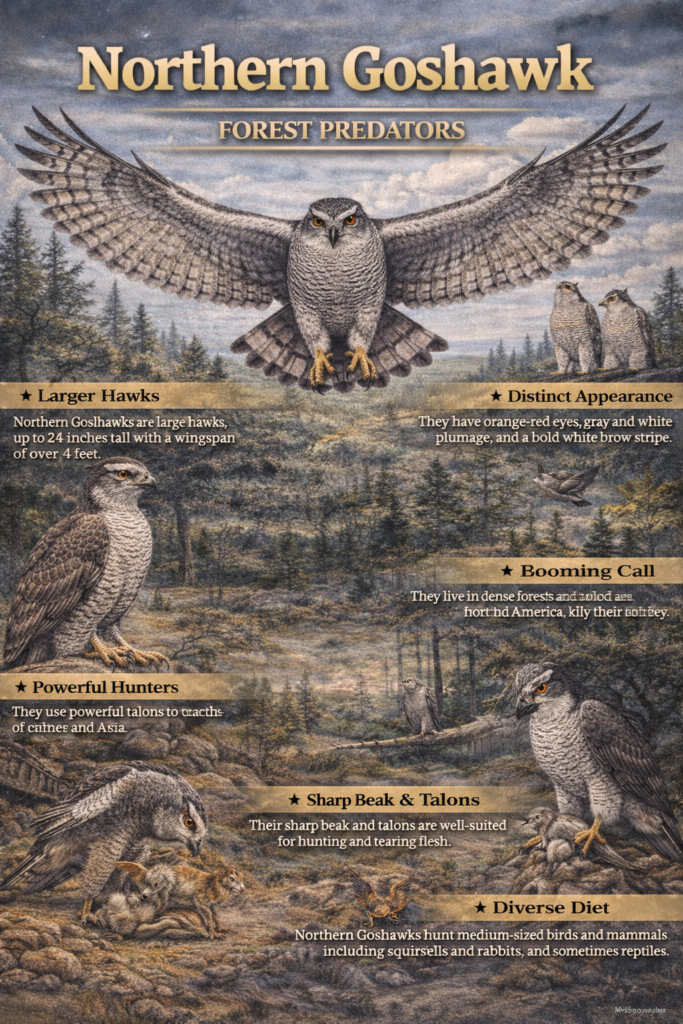
Northern Goshawk – Accipiter gentilis
Order Accipitriformes
Genus Accipiter – forest hawks
Northern goshawks, Accipiter gentilis, are large, powerful, diurnal birds of prey found across Europe, Asia, and North America, belonging to the forest hawk group. They are easily recognised by their slate-grey upperparts, pale underparts with fine barring, bold white eyebrow stripe, and fierce red to orange eyes in adults. Juveniles are browner with streaked underparts and yellow eyes, gradually developing adult coloration with age. Their broad wings and long tail are specially adapted for fast, agile flight through dense woodland.
Northern goshawks inhabit mature forests, woodlands, and mountainous regions, favouring areas with dense tree cover for nesting and open spaces nearby for hunting. Adults typically measure around 18–26 inches in length with a wingspan of approximately 3.5–4.5 feet, and weigh between 1.5 and 3 pounds, with females significantly larger than males, demonstrating pronounced sexual dimorphism. They are generally resident birds, though some northern populations may move south in winter.
They are highly skilled and aggressive hunters, feeding on a wide variety of prey including birds (such as pigeons and corvids) and mammals like rabbits and squirrels. Goshawks are known for their speed and stealth, often launching surprise attacks from cover and pursuing prey through trees with remarkable agility. Their flight is characterised by rapid wingbeats followed by short glides, allowing them to navigate complex forest environments with precision.
They build large stick nests high in trees, often reusing and adding to them over successive years. Breeding pairs are monogamous and highly territorial, aggressively defending their nesting area from intruders, including humans. The female typically lays 2–4 eggs, with the male providing food during incubation and both parents caring for the young after hatching.
Did you know the name “goshawk” comes from the Old English “goose hawk,” reflecting their ability to hunt relatively large prey such as geese? They have long been prized in falconry due to their power, speed, and hunting ability, particularly in woodland environments.
Northern goshawks have excellent eyesight and strong talons for capturing prey, and their compact, muscular build allows them to accelerate quickly and manoeuvre through tight spaces. They are often considered one of the most formidable woodland raptors due to their strength and bold nature.
SUPER FACT
EVOLUTIONARY ORIGINS
Hawks of the genus Accipiter evolved as specialised forest hunters, developing short, broad wings and long tails for rapid acceleration and tight manoeuvrability. The northern goshawk represents one of the largest and most powerful members of this group, perfectly adapted for pursuing prey through dense woodland habitats.